Showing posts with label tree. Show all posts

Thursday, July 13, 2023

Quercus suber plant

The cork oak, scientifically named Quercus suber, is an evergreen oak that comes from the central and western regions of the Mediterranean. It is a medium-sized oak tree that typically grows to heights of 40-70 feet and holds both commercial and aesthetic value. 

The leaves are simple, arranged alternately, and have an ovate to oval-oblong shape, measuring 3-7 cm in length. They have an acute tip, a somewhat rounded to cordate base, and 4-5 small teeth on each side of the margin. The upper surface of the leaves is glossy green, while the lower surface is covered in a white-gray tomentose layer. The leaf stalk, or petiole, is 8 to 15 mm long. The cork oak produces acorns, which are ovoid-oblong in shape and measure 1.5-3 cm in length. The acorns have a cup-shaped cap and a short stalk connecting them to the tree.

The cork oak has a distinctive appearance with its short trunk, thick branches, and rounded crown. Its trunk and major branches are covered in corky bark, which can be harvested from mature trees and used to make various products, including corks for wine bottles.

To thrive, the cork oak requires acidic, well-drained soils that range from moist to dry. It can tolerate full sun exposure or partial shade. This oak species is low-maintenance, resistant to deer, and can withstand drought conditions. It's important to be aware that oaks, including the cork oak, contain high levels of tannins in their leaves, bark, and acorns, which are toxic to horses.

The cork oak is tolerant of hot summers with prolonged droughts and mild, wet winters. While it is native to the Mediterranean basin, it can be grown in regions that have a Mediterranean climate.
Quercus suber plant

Thursday, May 5, 2022

Koompassia excelsa tree

The Koompassia excelsa is a species of tree in the family Fabaceae. It is one of the most prominent trees in the tropical rainforests of the Sunda Shelf. The tree is also known among the tallest trees in the world. It is found in Sumatra, Borneo, South Thailand, and Peninsular Malaysia.

The tree usually grows up to 75 meters tall but specimens up to 88 meters tall have been reported. The straight, cylindrical bole is usually up to 100cm in diameter, though specimens up to 270cm have been recorded.

Like most tall rainforest trees, they have huge buttress roots to support their weight. This is because the majority of the nutrients in rainforest soil are very near the surface, making large spreading roots more effective than deep ones. The tree has steep, thick buttresses up to 12 meters high.

Habitat of the tree: Lowland primary rainforest, mainly at moist locations along rivers, in valleys and lower slopes of hills, restricted to north of Selangor and Pahang (Kuala Lumpur-Kuantan latitude) on Peninsular Malaysia.

Wild bees often build their nests in the tops of this tree, and so local people commonly harvest honey from them. For this reason, and also because the trees are hard to fell, the trees are traditionally left standing when the forest is cleared.
Koompassia excelsa tree

Wednesday, July 4, 2018

Eastern red cedar tree

Eastern red cedar or botanically name Juniperus virginiana is an evergreen growing 40 to 50 feet tall in an oval, columnar, or pyramidal form (very diverse) and spreading 8 to 15 feet when given a sunny location.

Red cedar tree is known for its hardy nature and ability to grow on a wide variety of soil types and under harsh climatic conditions, such as drought and extreme temperatures. It develops a brownish tint in winter in the north and is sometimes used in windbreaks or screens.

While this tree is very tolerant of poor soil, it requires needs full sun. Its fragrant, scale-like foliage varies in color from gray-green to blue-green to light or dark green.

The fruit is a blue berry on female trees and is ornamental when produced in quantity. Birds devour the fruit and ‘plant’ it along farm fences and in old abandoned fields.

The silver-gray cones (fleshy coverings on seeds often referred to as juniper “berries) on females are quite attractive in the fall and winter. Male plants can be distinguished from female plants in the late winter because male cones (which bear pollen) are brown and are borne at branch tips giving male plants an overall brownish appearance in late winter.

The tree is a conifer native to North America that has been used for a variety of wood products, and its planting has been encouraged to help stabilize soil, reforest abandoned farmland, and provide cover for wildlife.
Eastern red cedar tree

Monday, October 23, 2017

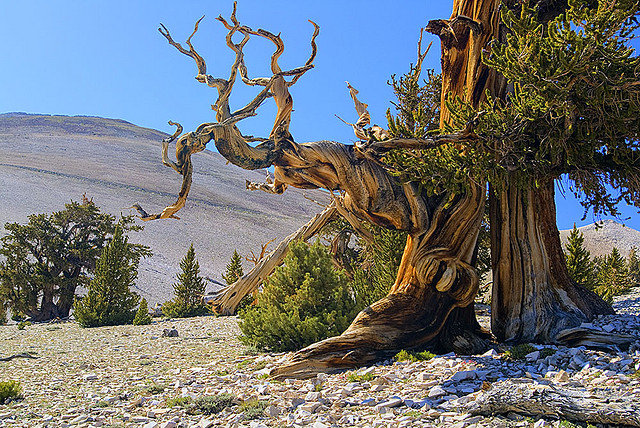
Bristlecone pine

Bristlecone pine occurs in small, scattered areas near or at timberline in the spruce-fir forests, where it usually occurs in pure stands.

A bristlecone pine six feet tall may contain as many as 900 annual growth rings. It is most interesting to note that old trees native to California, Colorado and Arizona, dwarfed by age and drought, have been estimated to be 7100 years old.
Found in the high, barren, windswept slopes of the South western states, these twisted and gnarled veterans have sculpture by time weather and the other elements into dramatic shapes and draped in picturesque colors.

The key to their great age and beauty partially lies in the ability of the species to adjust to the adverse and continually changing environmentally conditions. They are well suited to survive the scarcity of water and abidance of cold temperature.

Bristlecone pine cones are uniform in shape but vary greatly in size. The cones are 3” to 3.5” in length and are a deep chocolate brown at maturity. The cone scales are stout, thick and armed with a long, fragile curved (bristle-like) prickle from which the bristlecone pine receives its common name.
Bristlecone pine

Thursday, August 3, 2017

What is woodland?

Woodland is an assemblage of closely planted trees with associations of other plants and animals. They have grown up naturally but may have been extensively managed particularly in the past.

Woods and forests protect soils, retain moisture and store and recycle nutrients. They play a major role in maintaining the world climate, and their destruction releases carbon into the atmosphere causing climate change.
A distinction is made between primary and secondary woodland. Primary woodland is woodland that has been in existence since the last Ice Age, while secondary woodland, is woodland that has grown up in land that originally had some other use. This secondary woodland may be as old as ancient woodland but is known to have grown up over some former land use.

Woodlands are complex ecosystems and not only include obvious organisms such as trees and shrubs but also those living in the soil such as mycorrhizae (root fungi) which cannot be easily be seen.

Many species depend on the specialized conditions found in woodland for example, shade, deadwood, dampness and are therefore unlikely to be found outside this habitat.
What is woodland?

Saturday, October 31, 2015

Magellanic rainforest

Magellanic rainforest is found in the south where there is high precipitation (2.5 m per year) together with peat bogs, also known as Magellanic moorland, which transition to largely evergreen rainforest where the precipitation is approximately 0.8m per year and evergreen trees take over.

This rainforest occupies a zone of complex physical relief. In includes the foothills of the Patagonian Andes, vast ice fields and innumerable islands and fjords of southern Chile.
Nothofagus pumilio
The Magellanic rainforest are subject to colder and more-humid conditions without summer drought and overlap floristically and structurally with the forest in the southernmost position of the Valdivian ecoregions.

The dominant species in Magellanic rainforest are the tall lenga (Nothofagus pumilio) and guindo (N. betuloides) trees. Stands of lenga cloak the mountainsides up to 600m, while the guindo prefers the damp valleys and lakeshores.
Magellanic rainforest

Saturday, March 14, 2015

Poplar tree (Populus balsamifera L)

Other name for balsam poplar: cottonwood, tacamahac, tacamahac poplar; Populus tacamahaca Mill. The trees are dioecious, that is they have either male catkins or female catkins, which are wind pollinated.

Balsam poplar is a short-lived (120 years), medium-sized deciduous tree usually 20 to 25 m tall, with straight trunk 10 to 30 cam in diameter and long, thin, open crown, sometimes a large tree 24 to 30 m tall and 60 cm in trunk diameter.

The bark of mature balsam poplar trees was used by some native peoples for making buckets and other containers and the aromatics gum from the buds was used as glue.

The mass of fluffy hairs form the female catkins when fruiting was used as stuffing for pillows.

Balsam poplar has the distinction of occurring farther north in North America than any other tree species, occurring as distinct stands in river drainages on the Alaskan North Slope.
Poplar tree (Populus balsamifera L)

Friday, February 20, 2015

Blue Ridge Parkway

The Blue Ridge Parkway emerged at the end of a century-long process of developing an American aesthetic and style for public parks, first in nineteenth century cities and later in the huge expanses of national parklands.

Forests occupy almost all of the area south and southeast of the Blue Ridge, as well as the higher mountain in other parts of the country such as Grandfather, Beech, Rich, Stone, Pine Orchard and Snake Mountains’ Elk, Harmon, Riddle, Howard and Rocky Knobs and hanging Rock Ridge.

The most common forest the Blue Ridge Parkway passes through is the oak-chestnut forest. Its dominant trees are oaks: white, northern red, black scarlet and chestnut oak are all found in one place or another.

Many other kinds of trees appear occasionally. Depending on conditions at a particular site, one may find red maple, any of several hickories, white pine, sourwood, black locust, black walnut and both eastern hemlock and American beech. Tracts of forest on Flattop Mountain and near the head of Winkler Creel protect the water suppliers of Blowing Rock and Boone. The forests are also of value in the control stream flow and erosion and I furnishing food and shelter for wildlife.

The Blue Ridge Parkway is a wild flower lover’s paradise, offering a huge variety of native species during spring, summer, and fall. Some species can be found blooming over a considerably long period.
Blue Ridge Parkway

Tuesday, January 6, 2015

Tree of Acer saccharum Marsh (sugar maple)

Acer saccharum also known as hard maple or rock maple is one of the largest and prominent of the hardwoods of eastern North America.

The name ‘maple’ apparently originated in England, based on the Old English mapul, which may related to mopurr, the Old Norse name for maple.

It is cultivated on approximately 12.5 million hectares or 9% of the total hardwood land and encloses a net volume of about 130 million cubic meters or 6%  of the hardwood saw-timber in the United States.

The tree is large-growing, tall tree species with semi-pendulous branches. Usually 50-8- feet tall with a trunk diameter of 2-3 feet under optimum conditions sometimes 120 feet tall with a trunk 3-4 feet in diameter.

In the open, the bole divides 8- 10 feet above ground into stout, ascending branches that form a broad, ovoid, round –topped crown. Leaves have five lobes and are notably silver-glaucous below.

On the ecological front, it is prominent species of many forests in North America. The native peoples of North America collected sap in crude wooden, birchbark, or pottery vessels in the early spring after simply hacking wounds on the trunks of the trees.
Tree of Acer saccharum Marsh (sugar maple)

Thursday, December 4, 2014

The tree of Tectona grandis

The tree of Tectona grandis L. is indigenous to South Asia and South-East Asia, more specifically, India, Myanmar, Thailand and Laos.

The tree is well known for its versatile timber. Its heartwood combines several qualities like termite and decay resistance, lightness and strength, drying without warping and splitting, easy workability and attractive appearance, making it one of the world finest timbers.

Tectona grandis, commercially called teak, teek, or teca, is one of the most cultivated broad-leaved tree species in tropics.

It natural distribution is from 25° to 9° North latitudes and 73°  to 104°  East longitudes, in two covering most of Myanmar, northern Thailand and a small part of northwest Laos.

Over the past 50 years it has been planted extensively both within its native range and in other tropical and subtropical regions in Asia, Africa and America.

Teak is also well established in the Indonesian island of Java and some of the smaller island to the east of Java where it is believed to have been introduced from India about 400 to 600 years ago and become naturalized.

The most favorable growth conditions for teak exist in those tropical climates which have a n annual precipitation of 1,250 – 1800 mm and a more or less uniform temperature with a minimum of 12° C and a maximum of 38° C.

Tectona grandis tress and teak forest have some importance from an ecological point of view. The fruits, seeds, bark and leaves are important food sources for birds and mammals which also use large trees for shade.

Teak is a well-known multipurpose timber and the most important furniture wood. Other common uses include shipbuilding, exterior construction, carving, turning, paneling and woodware.
The tree of Tectona grandis

Monday, November 17, 2014

The tree of Dyera costulata

Dyera costulata is an emergent canopy tree in the lowland forests of South-east Asia. It is among the tall trees in open forests. The wood is a pale-colored light hardwood timber of great workability, limited durability and strength.

Dyera costulata is a large deciduous tree up to 60 m tall with diameters up to 2-3 m. It has a straight and clear bole up to 15-20 m, without buttresses. The leaves are in whorls and the trees are briefly and rather irregular deciduous.

The tiny white flowers open at night and fall off the next morning. The fruits are paired, wood tubes that split along one side when ripe, releasing that flattened, winged , wind-dispersed seeds.

The milky, latex-like substance produced by Dyera costulata and used by the indigenous people as a substitute for bungs, found in small but important place in modern industry.

It was used in the manufacture of chewing gum in the USA, for water fabrics and for mixing worth gutta-percha for electrical insulation.
The tree of Dyera costulata

Saturday, May 14, 2011

Redwood Trees

Redwood is an evergreen, highly productive tree with many individual exceeding 100 m in height.

Redwood trees are long lives and continue to increase in size for centuries. The oldest verified redwood tree is at least 2,200 years old but many redwood trees may be much older.

A giant redwood tree may grow as tall as a 30 storey building and live 3,000 years.

Redwood trees are the tallest living tree. The bark is reddish brown. The tallest known living redwood tree is 112.0 tall. The tallest historical reported redwood was Eureka Tree, which was cut in 1914 and measured 115.8 m tall.

Redwood tree live long because of built in protection against hazards. For instance, coast redwoods have thick bark. The bark is rich in tannic acid. The acid help keep insects away. The acid keeps fungus way also.

Redwood trees are one of the few species that absorb most of the required moisture through its needle rather than its roots.

Such phenomenon can only happen where the humidity is extremely high.

Redwoods also have an unusually storing network of roots, The roots spread out in the soil around each tree and then wrap around the roots of neighboring trees. This network prvides an anchor beneath the ground.
Redwood Trees

Wednesday, March 24, 2010

Pine Forest of The West of North American

Pine Forest of The West of North American
Some 25 pines cover western North American lands. Principal soft pines, those with soft wood and exhibiting gradual transition from spring wood to summer wood, include western white pine and sugar pine.

The most abundant hard pines, those usually with dense wood and exhibiting abrupt transition from springwood to summerwood are lodgepole pine, ponderosa pine, Jeffrey pine and jack pine.

High value western white pine grows from British Columbia south into north Idaho and western Montana’s Bitterroot Mountains and south through western Washington, western Oregon and through the Sierra Nevada of California.

Within this geographic range the seral tree is found from sea level to 2000 feet in moist valleys and up to 7000 feet on dry, exposed locales.

The species grows to 11,000 feet in the San Jacinto Mountains in California. The range of western white pine extends far beyond where the tree grows commercially and listed as a cover type.

Sugar pine, largest of the opine, exhibits its great size especially along the North Fork of the Tuolumne River and the North Fork of the Stanislaus River in Northern California.

Excellent growth is also noted along the San Joaquin and Feather River on the west facing slope of Sierra Nevada from 5000 to 7000 feet.

Stands are established from 1000 to 10,000 feet, the latter elevation in the Southern extremity.
Ponderosa Pine grows in commercially valuable stands throughout the West and beyond in the Great Plains. Dendrologists have charted five races of the species: Black Hill, Inland Empire (including British Columbia), Pacific, Arizona and California. Coats Range trees may be another race.

Jeffrey pine, earlier considered a variety of ponderosa pine, has a limited range in the southern Cascades to below the Sierra Nevada in California.

The tree’s elevational range is from 3500 feet to 10,000 feet, form north to south.
Pine Forest of The West of North American

The most popular posts

Other Interesting Articles

  • Turmeric (*Curcuma longa*) is best known for its bright yellow rhizome, which contains the well-known compound curcumin. However, the leaves of the turme...
  • Sapiosexuality describes individuals who feel primarily attracted to intelligence rather than physical appearance or other traditional markers of desirabil...
  • Napier grass ( *Pennisetum purpureum* ), commonly known as elephant grass, is one of the most valuable fodder crops for dairy farmers in tropical and sub...